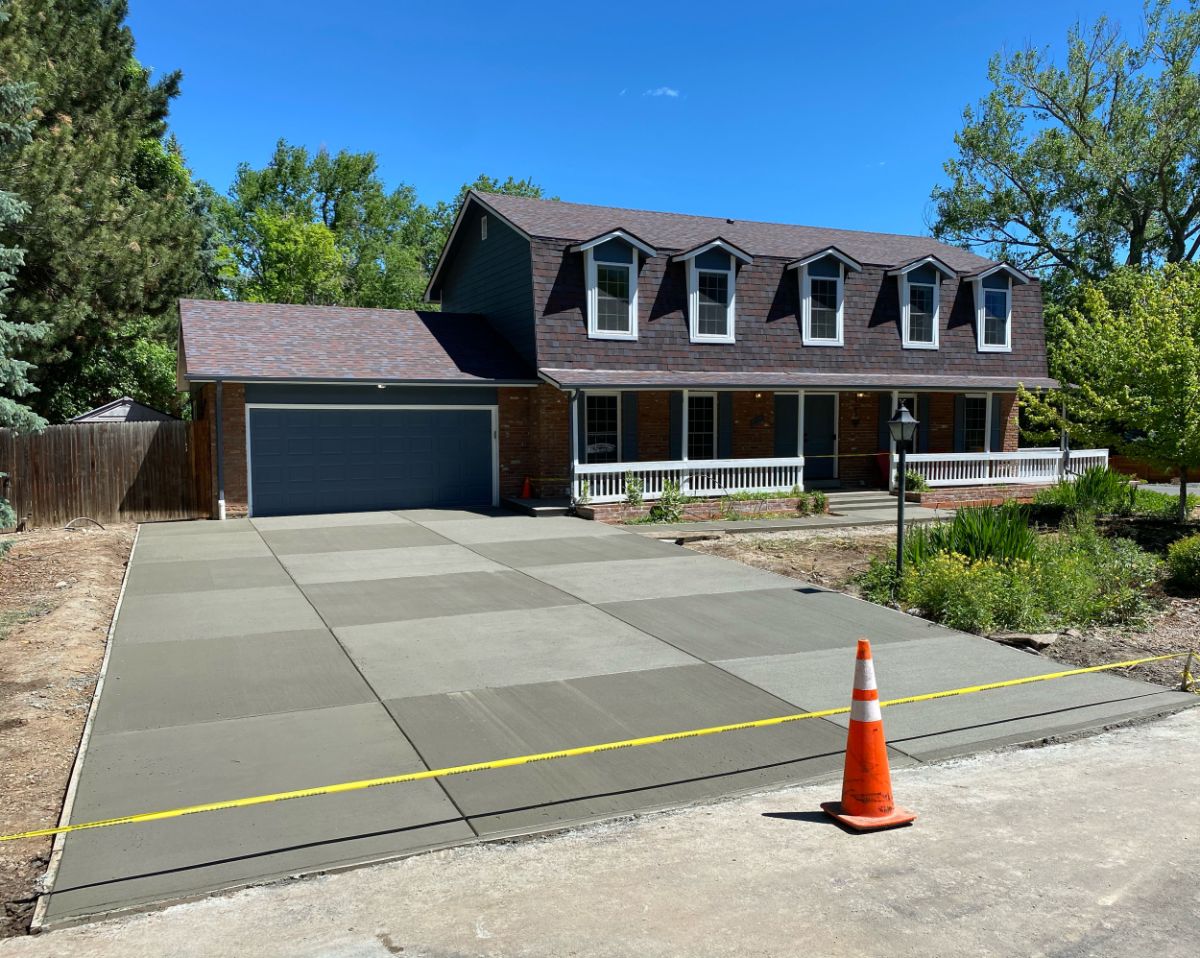
 Most people who call us have already spent an evening searching things like "how long before I can drive on a new driveway" or "is mudjacking worth it in Colorado." The answers online are usually written for Florida or Texas, not for a city that freezes and thaws dozens of times a winter and sits on expansive clay soil. So we pulled together the questions Denver homeowners ask us most, with short, plain answers and links to the longer guides we have written on each topic.
How much does a new concrete driveway cost in Denver?
For a standard residential driveway replacement, our current guideline is about $12.00 per square foot for a 4 inch slab and $13.50 for a 6 inch slab. That includes tearing out and hauling off the old concrete, reinforcement and full cleanup. A brand new driveway with no tear-out costs less per square foot. Total size, the condition of the base underneath and access to the site all move the number. Our concrete driveway cost guide breaks the pricing down by thickness, and the benefits of driveway replacement explains what you get for the money.
How thick should a concrete driveway be in Colorado?
A typical home driveway that sees cars, SUVs and pickups only needs a 4 inch pour, as long as the base is solid and the slab is reinforced. If you park an RV, a trailer or a work truck, or if delivery trucks regularly cross the slab, step up to 6 inches. Thickness alone will not save a driveway poured on a poor base, which is why base prep is on our list of 6 things every Denver concrete driveway needs.
What PSI concrete should I use for a driveway or garage floor?
Most driveway specs call for at least 4,000 PSI. We pour a 4,500 PSI mix on driveways, garage floors and parking areas because the denser mix lets in less water and holds up better against de-icing salts and freeze-thaw cycles. Since switching, we have seen less spalling and fewer hairline cracks. The full reasoning is in why we use 4,500 PSI concrete instead of 4,000 PSI. A good Colorado mix should also be air entrained, around 6 to 7 percent air, which gives water room to expand when it freezes.
Does a driveway need rebar or wire mesh?
Yes. Reinforcement does not stop concrete from cracking, but it holds the pieces together and keeps them level when a crack does happen. Our driveways include either 6 by 6 welded wire mesh or rebar set every 2 feet, plus fiber in the mix to cut down on shrinkage cracks while the slab cures. If a bid you received does not mention reinforcement, ask about it. Strengthening products in concrete explains the difference between rebar, wire mesh and fiber.
Why does concrete crack so much in Denver?
Three things work against concrete here: freeze-thaw cycles, clay soils that swell when wet and shrink when dry, and de-icing salt. Every slab will develop some cracks, which is why control joints are cut in on purpose so the cracking happens in a straight line where you want it. Cracks that widen, heave or leave one slab higher than the next usually point to a base or drainage problem. Those are worth having looked at before they become a trip hazard.
How long after pouring concrete can I walk or drive on it?
You can walk on new concrete after a day or two, but wait 21 days after the pour before driving any vehicle on it, including your everyday car. That gives the slab time to gain the strength it needs to carry the weight without cracking. Cold weather slows curing, so your crew will confirm the exact dates for your pour. Our driveway replacement process walks through each step from tear-out to cure.
Can you pour concrete in the winter in Colorado?
Yes, with the right precautions. Concrete should never be poured on frozen ground, and in cold weather the fresh slab has to be protected so it does not freeze before it gains strength. That usually means insulated curing blankets and watching the forecast closely. Cold-weather work can add cost, which is one reason a winter estimate may include conditions that a summer estimate does not. Spring and fall are the easiest seasons to schedule, and our calendar fills fastest then.
Does de-icing salt damage concrete, and should I seal my driveway?
De-icers are one of the biggest causes of surface damage we see. Salt and magnesium chloride tracked in from plowed streets work into the surface and, combined with freezing, cause flaking and spalling. On every new driveway we pour, we wait about 30 days for the slab to cure and then apply a penetrating salt protector, which protects the surface for roughly 3 to 4 years. Read the benefits of a salt protector on your driveway, and see our concrete sealing and rejuvenation service for existing driveways, patios and stamped concrete.
Should I mudjack my sunken concrete or replace it?
Mudjacking is cheaper and faster up front, and it can make sense for minor settling on a small walkway. It does not fix the soil or drainage problem that caused the settling, so slabs often sink again, and the drill holes stay visible. Replacement costs more but lets us correct the base and drainage and gives you a new, reinforced slab built to last decades. We compare both in concrete replacement vs mudjacking in Colorado and the downsides of mudjacking.
Is stamped concrete or pavers better for a patio in Denver?
Both can look great. Stamped concrete is one continuous slab, so there are no joints for weeds to grow through and no individual pieces to settle or shift, and it can be colored and patterned to look like stone, slate or wood. Pavers are easier to patch one piece at a time. We break down cost, upkeep and looks in stamped concrete vs paver patios. For ideas, see enhance your outdoor space with stamped concrete, stamped concrete for your patio and our concrete patio page.
How do I pick colors and patterns for stamped concrete?
Start with your house: pull a color from the roof, brick or trim, then choose a base color and a darker release color to highlight the texture. Lighter colors stay cooler underfoot in the summer sun. Our guide on how to choose colors for a stamped concrete project walks through the process, and you can browse stamped concrete color combinations, the release color chart and stamped concrete patterns. The stamped concrete FAQ answers questions about upkeep and resealing.
Can I tear out my old concrete myself to save money?
You can, but most homeowners underestimate the work. A driveway weighs several tons, breaking it up takes heavy equipment, and disposal fees add up quickly. Damaging a sewer line, sprinkler system or your foundation while breaking concrete costs far more than you would save. Should I tear out my own concrete or hire a professional? covers the tradeoffs, and our concrete removal service handles demo and haul-off.
Is epoxy or polyaspartic better for a garage floor?
Both turn a plain garage slab into a floor that resists oil, chemicals and hot-tire marks and is easy to clean. Polyaspartic coatings cure much faster, so your garage is back in use sooner. Compare them in the benefits of epoxy floor coatings, the ultimate guide to epoxy floor coatings and what is polyaspartic? If the slab itself is cracked or sunken, start with a new garage slab and coat it once it has cured.
Does new concrete add value to my home?
Curb appeal is the first thing buyers and appraisers notice, and a cracked, stained or sunken driveway is an easy reason for a buyer to ask for money off. New driveways, walkways and patios also make the yard more usable while you live there. See boost your home's value with new concrete and popular residential concrete projects in Colorado for ideas.
How do I choose a concrete contractor in Denver?
Get at least two written bids and compare them line by line, not just on total price. A low bid often leaves out tear-out, base prep, reinforcement or cleanup. Ask what PSI mix they use, how they handle drainage, and whether they are licensed and insured in your city. Then read their reviews and look at photos of recent work. Our tips for choosing your concrete provider has a full checklist, and you can see our recent concrete jobs around the metro.
Still have a question?
Denver Concrete Company has poured driveways, patios, sidewalks and stamped concrete across the metro since 2014, including Arvada, Lakewood, Littleton, Wheat Ridge, Westminster and Parker. If your question is not covered here, ask us during your estimate. We would rather answer it before the pour than after.
Have a question about your project?
We will answer it on site, check your base and drainage, and give you a written price for your driveway, patio or sidewalk.
Call (303) 848-8447 Get a Free Estimate
Free on-site estimate. Most customers hear back the same day.